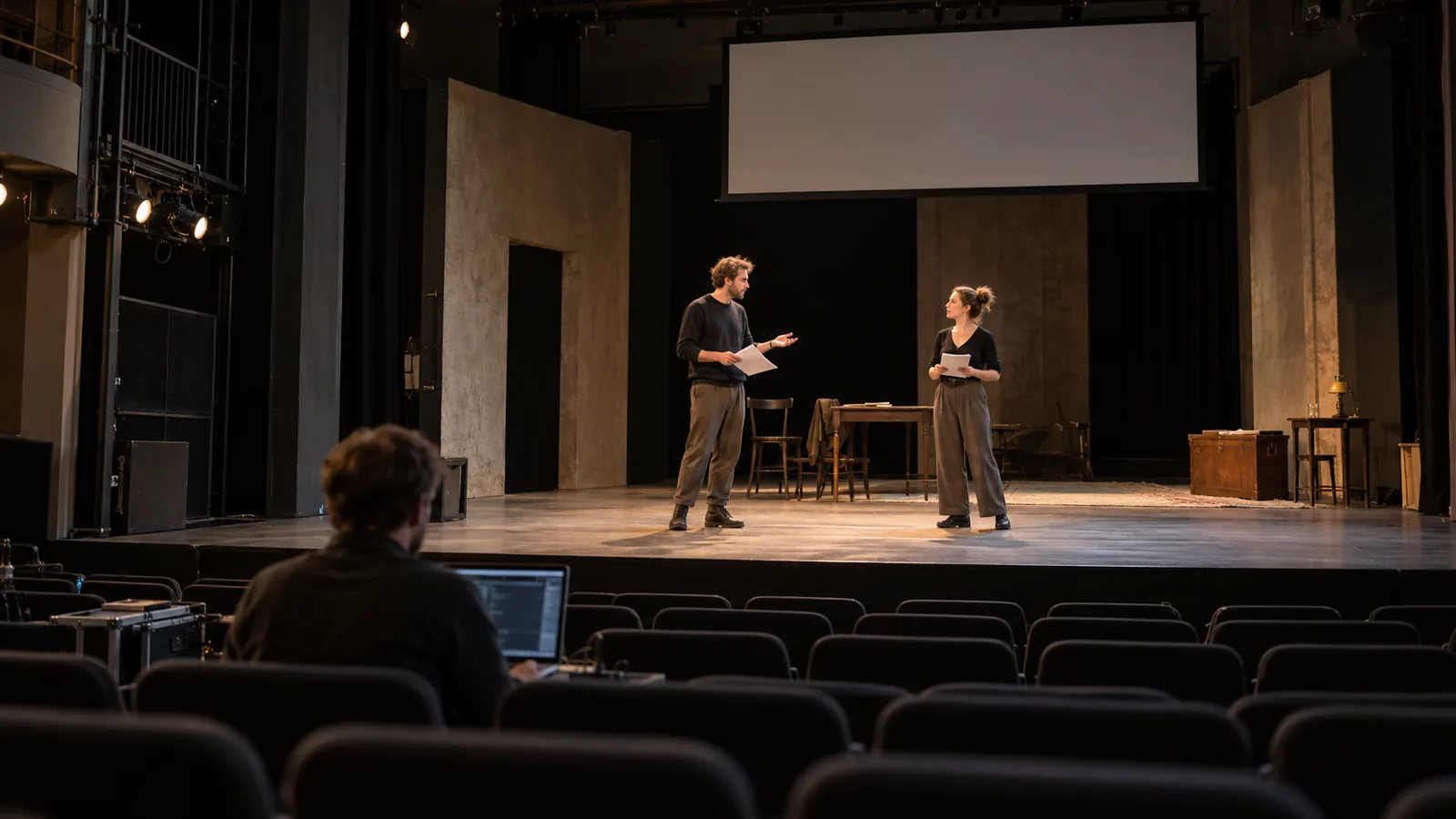
Distinguish surtitles, captions and interpreting
Surtitles are text displays often placed above or beside a theatre stage. For a scripted production, a prepared translation can be edited for reading and shown at agreed cues. Literary judgement and an operator following the performance are central to that workflow.
AI live translation is generated from the current microphone signal. Processing takes time and recognition can fail. Klausi produces translated text; it is not a tool for cueing a prepared play script or delivering spoken interpretation.
| Situation | Planning approach |
|---|---|
| Scripted production | Consider prepared surtitles agreed with the artistic team |
| Unscripted audience discussion | Trial live text with orderly speaker changes |
| Spoken translation required | Plan professional interpreting and suitable audio equipment |
Scripted production
Unscripted audience discussion
Spoken translation required
Choose a manageable theatre use case
An introduction, rehearsal discussion or post-show talk differs from the performance itself. A moderator can control turns and ask for clarification when the output is unclear. Start with a short discussion and someone who can assess both languages.
Music, whispers, rapid dialogue and overlapping voices make recognition harder. A clear welcome is not a sufficient test. Rehearse a representative passage using the planned microphones and actual speaking pace.
Select languages for Germany, Austria and Switzerland
Ask about language needs when inviting guests or taking bookings. German–English may suit an international introduction. A visiting production or community discussion might require German–Turkish or German–Polish. The stage language alone does not identify the audience’s needs.
In Switzerland, German–French or German–Italian may also be relevant. Klausi offers 13 selectable languages, but an event uses one pair in both directions. See the complete language list. Swiss German is not a separate language option. Test dialect and artistic language separately.
Agree on sound and display with the technical team
Position text so guests can follow the stage and read without repeatedly turning their heads. Check the back row, side seats and seats intended for particular access needs. A bright display should not unintentionally change the lighting design.
Every contribution to a post-show discussion needs a suitable microphone. Agree which audio output provides an intelligible signal. Klausi needs a current browser, microphone permission and internet. The projection guide explains the readability check.
Run a rehearsal with an explicit decision
Define the purpose before the rehearsal: for example, following a post-show discussion in another language. Assess specific sentences, names and speaker changes afterwards. Record where meaning or attribution was lost.
- Assign one person to operate the session and another to read from the audience.
- Rehearse a typical question and answer in both languages.
- Assess delay, text size and visible history inside the auditorium.
- Prepare a moderator announcement and backup connection for interruptions.
- Adjust the provision before advertising it if understanding is insufficient.
Agree artistic permissions and access provision
Agree with the artistic team, authors and translators which text may be shown publicly. An automatically generated history is not an approved translation of the play. Personal contributions from the audience also need preparation.
Translated text alone does not cover every access requirement. Assess professional captioning, sign language and other support against actual needs. The guide to live captions and accessibility explains the differences.
Prepare the agreed workflow in Klausi
Create an event for the discussion you have tested, choose the language pair and check both projection and guest access on a second device. Budget for the discussion, rehearsal and a reserve. See current minute packs.
The setup guide covers the start. For a programme mixing readings and conversation, use the guide to book launches and author readings.